

Wednesday, 31 January 2018

Monday, 29 January 2018


Sunday, 28 January 2018
Paprika - Film Review
 |
| fig. 1 film poster |
Based off Yasutaka Tsutsui’s novel of the same name,
‘Paprika’ is a 2006 film directed by Satoshi Kon. The Japanese film takes
cultural roots of its origin encompassing NEET culture, Maneki-nekos (lucky
cats) and variation in character proportions. While the film’s plot is easier
to follow the animation creates a more complex and confusing story. Never the
less the style proves to be one of the defining features of the film. ‘Paprika’
follows Doctor Atsuko Chiba who must recover several stolen devices that allows
one to enter another’s dream.
With the plot in mind it is possible to seed several themes
into the story, one of which is more evident. In the words of the antagonist of
the film, the chairman, “the dreams are horrified… that their safe refuge is
destroyed by technology.” While it is clear that the chairman disapproves of
new technology it also highlights the potential fear. There have been many
films before that have explored technology getting out of hand, one of the more
famous examples being ‘Terminator’ (1984). Despite being a far stretched
technophobic example its represents a similar concept shown in ’Paprika’. The
device while invented for the betterment of humanity proved powerful and in the
wrong hands capable of great damage. This falls into the long and arduous
debate of whether or not technology should become so powerful. The device itself
proves so, without limitations it can merge both reality and dreams. The dream
aspect is well portrayed though kon’s choice in medium.
 |
| fig.2 an example of the dream world |
The story is portrayed through the use of animation in the style of anime (synonymous to Japanese culture), mixing 2D and 3D elements. This form of animation is a product that is commonly associated with NEET culture as mention above. A culture that has been recognised as a rising issue in society as industry targets mostly males of ages up to 30. Due to the harsh circumstances and expectations of Japanese society it is easier for some to find escape in media and indulging in animation and its associated products. Despite this the anime style has been able to portray a number of individual and unique styles. Variation in character proportions, movement and design gives anime a large expanse in ways of expressing itself.
Tsutsui’s world is presented in a manner of various playful colours mixed in with a large amount of morphology. This is heavily present throughout the dream sequences as inanimate objects come to life and the abstract begins to intrude the real world. Animation has been used to tell many stories some more ordinary than others, in the case of ‘Paprika’ the medium is used to great effect in shaping and describing the dream world. The style is also well known for the 1988 film ‘Akira’ which proposes a number of mad and explosive moments. ‘Paprika’ is not too dissimilar in this manner. The two worlds of reality and dreams are well defined with reality being far more mundane contrasted by the dramatic dream world. Critic Alex Naylor describes kon as ‘an engineer of delirious, dizzy trips through the psyche, but a spiky, tough social critic too’ (2008) which is evident in this particular piece of work.
Since the 2006 film there was plans of a live adaptation,
directed by Wolfgang Petersen. However the animation provides a unique style to
the story that a live-action retelling cannot recreate, limiting the amount of
creative choices possible. This became evident when Christopher Nolan’s
‘Inception’ (2010) was released during the early stages of development of
Petersen’s film. It appears that due to the similar natures of the concepts
Petersen stopped progress as its success as a more original film would have
been restricted. This further provides support that animation played a pivotal role
in the film.
The director, Satashi Kon sadly passed away in 2010 before
he could complete his next work ‘Dreaming Machine’. Never the less it is clear
that Kon has a strong image that he has planned for each of his work being able
to execute and direct his team to fulfil his dream. Critic Paul Jackson
comments on this ‘renowned for injecting a staggering level of lived-in detail
into each of his compositions’ (2008) moving on to describe how much detail
each shots contains.
Bibliography
Jackson, P. (2008). Paprika.
[Online] Available at: http://www.midnighteye.com/reviews/paprika/
[Accessed: 28/01/18]
Naylor, A. (2008). Paprika:
the stuff of dreams for. [Online] Available at: filmgoershttps://www.theguardian.com/film/filmblog/2008/jun/17/paprikathestuffofdreamsfo
[Accessed: 28/01/18]
Illustration list
fig. 1. Film Poster [Online] Available at: http://img.moviepostershop.com/paprika-movie-poster-2006-1020689313.jpg [Accessed: 28/01/18]
fig. 2 An example of the dream world [Online] Available at: https://blogger.googleusercontent.com/img/b/R29vZ2xl/AVvXsEj-VCQcLnj4q8UlUstfIHjNlXlZtLnmyPNEh_eTSsvnQ-njBWSDZQVq7z9bEdV5rLrQDaj496tsAmTN5ie-4BdqyF91K-hB4Iaduciycs1NQ_zXB1kL7FyFmXmV6QNsudHnxCXnJBQrLoov/s1600/paprika.jpg [Accessed: 28/01/18]
Thursday, 25 January 2018
Toolkit 2 - Graphic design, A Meal to Die For
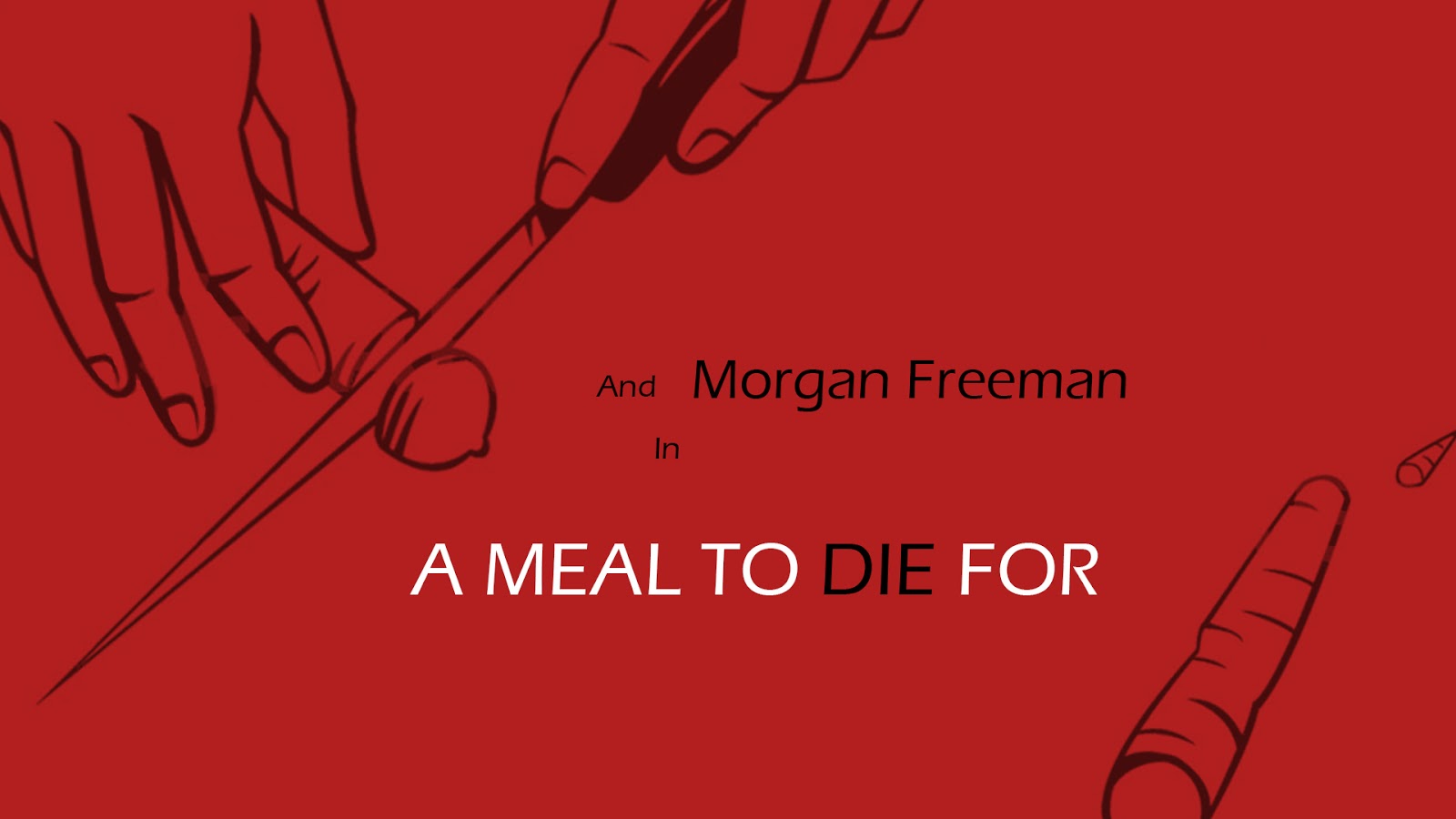
In today's class exercise we were tasked with creating several title cards using a number of black and white clip art images. The imaginary film title that I have chosen is 'A Meal to Die For' and matching images, font and colour scheme had to be picked. Multiple factors also had to be taken in consideration from the lesson in terms of graphic design.


Wednesday, 24 January 2018
Premise - Concept
For the sleep paralysis concept there are a number of stories that go into the individual experiences of being trapped on one's own body. However it leaves a lot of room for interpretation e.g. the dream world could exist as a black plane as seen in the example below. Never the less sound design will play an important role in the animation.
For the tank idea there are many documentaries that focus on wartime stories, one particular film that uses animation to describe the war stories of multiple people is 'Waltz with Bashir'. I find both the animation style and how the individual stories told.
Alongside other war stories 'Paths of Hate' is one that puts two fighter pilots against each other. The animation style is something that I may try to replicate and is reminiscent of Waltz with Bashir.
Monday, 22 January 2018


Saturday, 20 January 2018
Mary and Max - Film Review
 |
| fig.1 film poster |
“Mary and Max” is a 2009 Australian film directed by Adam Elliot. The film starts in 1976 and runs throughout the 70s and 80s, presenting an important factor to the story. While the piece contains moments of laughter the story remains bleak evoking powerful emotions. Even the colour scheme itself reflects this with greys and muddy browns. But never the less Elliot’s film could be described as a potent one.
There is a unique quality in Elliot’s film thanks to the sound design chosen. Over the duration of the animation there are very few spoken words by the characters. Instead action speaks louder than words with each character model capable of portraying a wide range of expressions including anger and embarrassment. Accompanying the footage is the playful and contrasting sound track helping to prepare the audience ahead as the film begins to evoke melancholy feelings.
The film covers a number of themes including loss of family, friendship and mental disabilities. However one particular theme that stood out was ‘coming of age’. It can be debated that this is not the core theme of the film; perhaps ‘coming of age’ is not the complete and correct term. It is more accurately described as maturing and finding one’s place in the world. It may seem strange that this is what could be taken from “Mary and Max” as there are numerous underlying themes, some of them more adult than others.
Mary and Max could be seen as children who never grew up but retain adult privileges. As Max’s past is delved into it is apparent that he was always lonely, isolated and shunned. At the age of 44 this has not changed. He indulges in his two guilty pleasures chocolate and ‘Noblets’ a child’s television show that exists in Elliot’s universe. Mary also has a similar indulgence of sweet treats and the show hinting towards the child-like innocence shared between the two. It is because of these common traits the two are able to get on so well forming the strong bond even with the physically distance between them.
Max only matures when he is able to make the realisation that people are ‘imperfect’, his gift to Mary of children’s toys resembles Max moving beyond his child-like fascination. This theme is more apparent for Mary as the film takes place over her physical change from a child to an adult. Ultimately she finds her place in the world as a responsible mother. Other themes support the ‘coming of age’ as ‘death’ challenges the characters and ‘friendship’ helps both Mary and Max find where they belong.
This is reflected in the medium used for this film. Rather than opting for live action or traditional hand-drawn animation Elliot used Claymation, a style often related with “Wallace and Gromit”. Alongside being synonymous to “Wallace and Gromit”, Claymation is often related to children’s cartoons. The innocence in the style mirrors that of the main characters. Despite the nature of Claymation there is a rather eerie sense that is applied in the form of the dark colour schemes chosen. Film critic Andrew Pulver describes the style as “sickly-cute, alarmingly grotesque, and right-on at the same time – often in the very same scene” (Pulver, 2010). It is obvious that Mary and Max belong to separate worlds, (somehow making the all-important connection as friends) as Max’s world is grey and Mary’s muddy tones of brown. Even the use of a narrator in this particular fashion also harks back to old childhood cartoons.
 |
| fig. 2 Max’s grey world and Mary’s muddy brown one |
One of the other important themes presented in the film surrounds mental disabilities in particular Asperger’s. As Max has Asperger’s during the 70s he is often looked over by society. Psychology was a comparatively recent science when compared to the likes of physics and biology. With the current understanding and wide spread knowledge it is hard to imagine how such people were dismissed.
Film maker Adam Elliot has received over 100 film awards and for good reason. The majority of his works have a bittersweet tone which is true in “Mary and Max”. Refusing to work with major film companies, each of his films require a long process and shot independently. His first known film ‘Uncle’ (1996) had a total run time of around 6 minutes. With each passing film Elliot extended the duration of his animations with ‘Harvie Krumpet’ his 2003 film having 23 minutes of run time. Alongside the duration Elliot also pushed the way his content moved his audience emotionally. This is evidenced in an interview where he stated, “After Harvie Krumpet, I wanted to tackle something longer and meatier” (Desowitz, 2009) and as the interview continues it is clear that Elliot is not driven by money but instead passion. He wants to provoke the audience and engage them.
“I try to make films with depth, substance; films that deeply engage, move and make the audience think” (Desowitz, 2009)
While the film retains strong elements it is restricted to being screen at film festivals. In the end “Mary and Max” is a sad tale that has received positive reviews from both critics and audience alike winning several awards.
Bibliography
Desowitz, B. (2009). ‘Mary and Max': Elliot and Clayography. [Online] Available at: https://www.awn.com/animationworld/mary-and-max-elliot-and-clayography [Accessed 19/01/18]
Pulver, A. (2010). Mary and Max – review. [Online] Available at:
https://www.theguardian.com/film/2010/oct/21/mary-and-max-review [Accessed 19/01/18]
Illustration list
Fig. 1 Film poster. [Online] Available at: http://img.moviepostershop.com/mary-and-max-movie-poster-2009-1010550958.jpg [Accessed 19/01/18]
Fig.2 Max’s grey world and Mary’s muddy brown one. [Online] Available at: https://agoodmovietowatch.com/wp-content/uploads/2013/08/mary-and-max-together.jpg [Accessed 19/01/18]
Friday, 19 January 2018
Artist Toolkit 2 - Mudbox, Fruit Bowl
Mudbox is an Autodesk package that allows models to be shaped, textured and painted in greater detail. For the task today the class had to create a fruit bowl with a texture that reflects a specific material. I have chosen aged brass replicating an old artifact. More precise shapes were also added in the design including various shapes and a Celtic wreath through the use of stencils that could also be used to help create a more authentic texture.

Subscribe to:
Posts (Atom)